
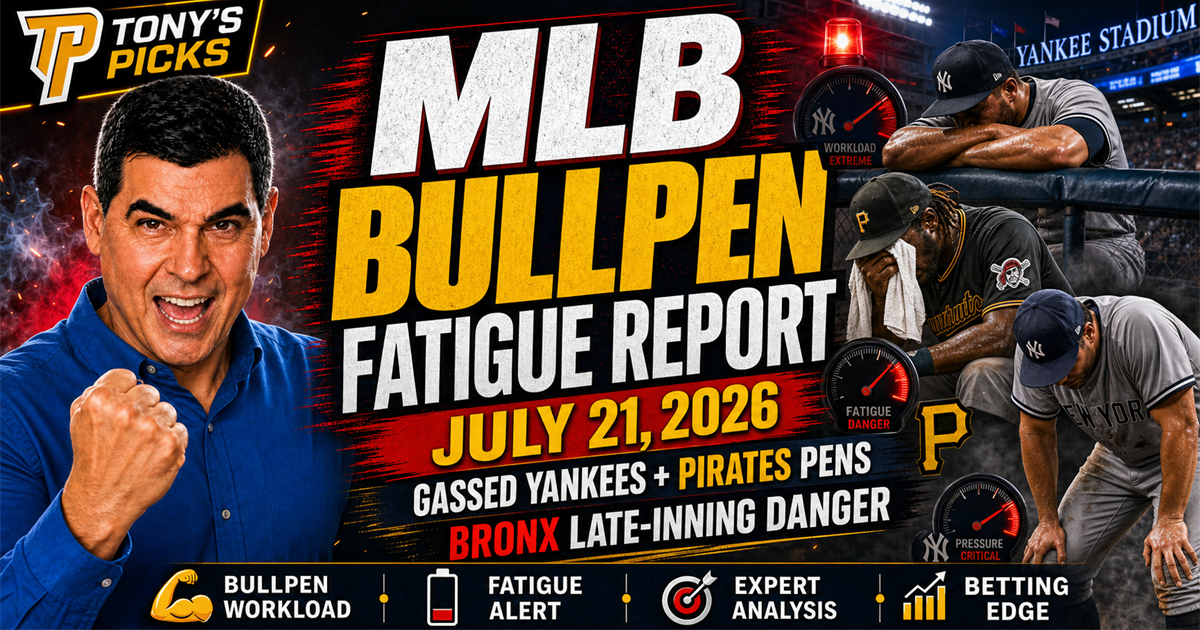

This is Tony T from tonyspicks.com with the daily bullpen read for Tuesday, July 21, 2026. Games are won and lost in the sixth, seventh, and eighth innings far more often than the box score suggests — a tired relief corps is the softest underbelly in baseball betting, and it is exactly where late-game totals, live overs, and full-game money lines quietly leak value. Every workload figure below comes straight from our pitch-level database, June 1 through July 20, 2026, a 619-game window. The one number to anchor on is our fatigue score, which I will define once and use throughout: relief batters faced over the last three slate days, plus six points for every reliever a team used on back-to-back days. Higher score, more tread worn off the tires.
Red Zone — The Taxed Pens Tonight
These are the four most fatigued bullpens on the board, cross-referenced against tonight’s matchups.
New York Yankees (fatigue 88, most taxed in baseball) — hosting Pittsburgh. The Yankees top the entire league in bullpen fatigue at 88, with 64 relief batters faced over the last three days and four different relievers used on back-to-back days — the only pen on the slate carrying four B2B arms. New York’s relief corps has actually been effective when rested (1.07 relief runs allowed per game, a 23.6% strikeout rate), but effectiveness and availability are different questions. Four back-to-back arms is a manager staring at a short menu.
Play: Yankees late-inning relief exposure — lean full-game and F5-to-full “swing” spots Grade: B (Depleted High-Leverage Menu) Key Edges:
- League-worst fatigue score of 88
- 64 relief batters faced across the last three days
- Four relievers deployed on back-to-back days — most on the board
- Only a 15.8 relief BF per game workload rate normally, so this is a spike, not a baseline
Read: The Yankees pen is elite on talent but stretched on availability tonight. If this game is tied or within a run late, the arms Aaron Boone trusts most may already be unavailable, and that is where the value drifts to the offense and the late-game over.
Texas Rangers (fatigue 74) — hosting Chicago White Sox. Texas sits second at 74, and this is the fatigue profile I trust least defensively: 56 relief batters faced over the last three days, three relievers on back-to-back days, and — critically — a 2.2 relief runs allowed per game that is already among the worst on the board before you factor in the tired arms. A shaky pen that is also gassed is a double negative for anyone holding Rangers unders late.
Detroit Tigers (fatigue 73) — at Chicago Cubs. The Tigers carry a 73 fatigue score on 61 relief batters faced in three days and two back-to-back arms. Their relief run prevention has held up (1.15 relief RA/G, 22.9% K), but 61 batters faced in three days is heavy lifting, and a Wrigley afternoon-into-evening spot is not where you want a worn pen protecting a lead.
Pittsburgh Pirates (fatigue 70) — at New York Yankees. Here is the angle of the night: the Pirates are the fourth-most fatigued pen at 70, driven by a slate-high 70 relief batters faced over the last three days, and they are walking into the Bronx to face the most fatigued pen in baseball. Both bullpens in one game are running on fumes. Pittsburgh’s relief unit has been leaky in this window (2.27 relief RA/G, the roughest full-season relief run rate among tonight’s red-zone clubs), so when both benches are thin, the late innings become a scoring environment. That is the single best “both pens gassed” spot on the Tuesday slate.
Green Zone — The Freshest Pens Tonight
The flip side: rested relief corps whose managers have a full deck to deal with late.
Toronto Blue Jays (fatigue 34, freshest real pen) — hosting Tampa Bay. Toronto is tied for the lowest fatigue score on the board at 34, with just 34 relief batters faced over the last three days and zero back-to-back arms. If tonight’s game is close, the Jays’ high-leverage relievers are all available — a quiet edge for Toronto in the late innings and a reason to be cautious on any live over that leans on the Jays’ pen cracking.
Featured Analysts & Cappers
Read free daily matchup breakdowns and track documented betting records.
Baltimore Orioles (fatigue 34) — at Boston. Baltimore matches Toronto at a 34 fatigue score, 34 relief batters faced in three days, and no back-to-back usage. A rested Orioles pen with a 1.66 relief RA/G travels to Fenway with a full complement of arms.
Seattle Mariners (fatigue 35) — hosting Cincinnati. Seattle checks in at 35, with a slate-low 12.4 relief batters faced per game workload rate across the window and just 35 relief batters faced in the last three days. Fresh arms behind a strong first-inning club (see today’s NRFI report) makes the Mariners a tough late-game out.
Chicago White Sox (fatigue 37) — at Texas. The White Sox pen sits at 37 and, at a 0.97 relief RA/G, has been one of the stingier relief units in this window. A rested Chicago pen facing a gassed Texas pen is the mirror image of the Bronx spot — the fatigue differential points toward the Sox in the late frames.
Reliever Watch
Individual arms worth tracking, with “pitched yesterday” flags noted because a rested-vs-used tag can flip a manager’s eighth-inning decision.
- D. Bednar (New York Yankees): 60 batters faced, zero runs allowed, a 0.0 runs-per-BF mark and a 30.0% strikeout rate. Elite — and he did NOT pitch yesterday, so he is the one high-leverage Yankee who is both nasty and available even as the pen around him tires.
- B. Headrick (New York Yankees): 88 BF, one run, a microscopic 0.011 runs/BF and a 34.1% K rate — but he pitched YESTERDAY, one of the four back-to-back arms dragging New York’s fatigue score to 88.
- A. Munoz (Seattle Mariners): 58 BF, three runs, 0.052 runs/BF, a 36.2% K rate, and he did NOT pitch yesterday. Fresh pen, fresh closer — a hard door to walk through late at T-Mobile Park.
- J. Hader (Houston Astros): 69 BF, three runs, 0.043 runs/BF, a slate-leading 40.6% strikeout rate — but he pitched YESTERDAY, so availability is the question mark, not stuff.
- M. Leiter Jr. (Athletics): 38 BF, one run, 0.026 runs/BF, a 34.2% K rate, and no back-to-back flag — a quietly rested weapon in an Arizona matchup.
- R. Zeferjahn (Los Angeles Angels): 80 BF, three runs, 0.037 runs/BF, a 40.0% K rate, did NOT pitch yesterday — a fresh, high-strikeout arm for the Angels in their late West Coast game.
How to Use This
Fatigue data is a late-game tool, not a first-pitch tool. Three ways I put it to work:
1. Totals and live overs. When both pens are in the red zone — tonight’s Pirates-at-Yankees is the textbook case — the late innings turn into a scoring window. That is a spot to shop the full-game over or, better, to wait and pounce on a live over after a quiet start when the price is fat. 2. F5 versus full game. A fresh pen (Toronto, Baltimore, Seattle, White Sox tonight) argues for backing a team on the full game rather than just the first five; a gassed pen argues the opposite — take your winner through five and get out before the tired arms take the ball. 3. Side selection in close games. In a pick-’em late-game situation, the fatigue differential is a tiebreaker. Rested White Sox pen versus a worn, leaky Texas pen is a real, quantifiable edge on the Chicago side after the starters exit.
Bottom Line
The Tuesday headliner is the Bronx, where a league-worst-fatigued Yankees pen (88) meets a slate-high-batters-faced Pirates pen (70) — both benches thin, late runs live. On the other side, Toronto, Baltimore, Seattle, and the White Sox all bring rested relief corps that reward full-game backers. For the complete daily card, pair this with our NRFI report and the “Free MLB Picks For Today” roundup at tonyspicks.com. This is analysis, not a guarantee — the bullpen picture can change with one blowout or one extra-inning marathon.
Lines and probable starters are subject to change before first pitch; bullpen availability can shift with a single late-inning move, so confirm the situation before you bet.
FAQ
What does bullpen fatigue mean for betting? It measures how heavily a team’s relievers have been used recently. A tired pen is more likely to allow late runs, which pushes value toward overs, live overs, and the opposing offense in close games after the starters exit.
How is the fatigue score calculated? Our fatigue score equals the number of relief batters faced over the last three slate days, plus six points for every reliever a team used on back-to-back days. A higher score means less rest and a shorter list of trusted late-inning arms.
What does the “pitched yesterday” flag tell me? It marks relievers who worked the previous day and may be unavailable or limited tonight. A dominant reliever who pitched yesterday is a stuff-vs-availability question, while a rested one is a live threat to close the door.
Please gamble responsibly.
Tony Tellez is the author/editor of TonysPicks, offering daily free sports picks and expert analysis for legal wagering. A seasoned handicapper with a TV show background and significant online presence, Tony provides data-driven insights across NFL, NBA, MLB, NHL, UFC, and more, focusing on valuable betting information.