
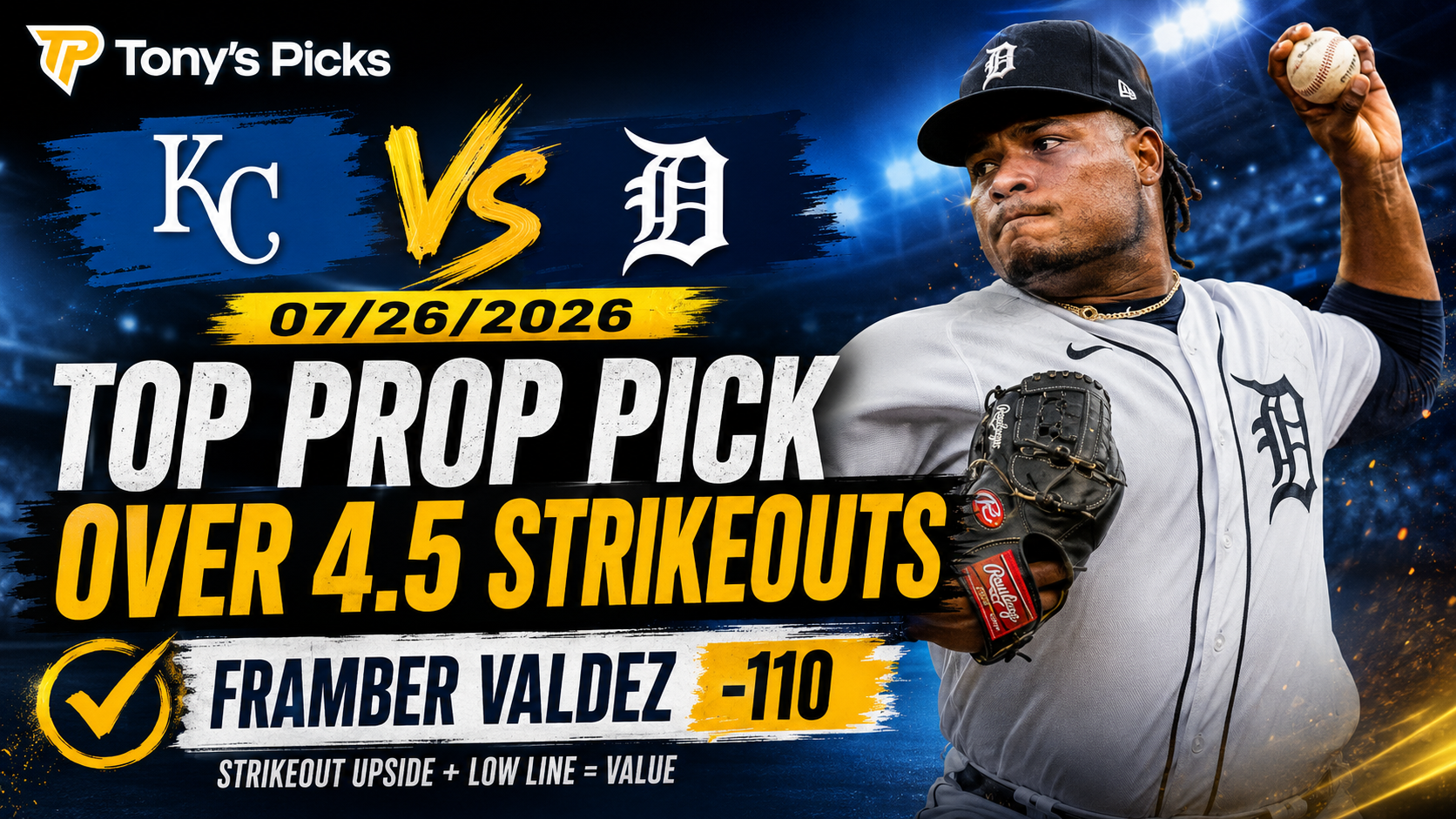

Framber Valdez Over 4.5 strikeouts at -110 is the best player prop for Sunday’s Kansas City Royals versus Detroit Tigers matchup. The strongest reason is the combination of a reachable five-strikeout threshold, a normal starter’s workload, and a breaking-ball package that projects better than his uneven recent results. My projection lands near 5.2 strikeouts, above the posted line and the 52.38% breakeven rate attached to the current best odds.
This is an opportunity-first wager, not a claim that Kansas City is an extreme swing-and-miss offense. If Valdez avoids another early blowup, he should face roughly 22 to 24 batters, giving him enough chances to record five strikeouts.
Best Player Prop for the Matchup
The complete recommendation is Framber Valdez Over 4.5 pitcher strikeouts at -110. His season average is 4.4 per start, but that figure is depressed by several short outings, including his two-out start against Chicago. At near-even pricing, the reduced threshold matters more than the raw season hit rate.
Starting-Pitcher Matchup
Detroit is expected to start Valdez, a left-hander with a 5-7 record, 4.57 ERA, and 88 strikeouts in 1081/3 innings. Kansas City counters with right-hander Luinder Avila, who enters 5-3 with a 4.86 ERA and 57 strikeouts in 63 innings. The game is scheduled for 1:40 p.m. ET at Comerica Park.
Pitcher Skills and Expected Performance
Valdez’s 4.30 xERA, 4.34 xFIP, and low-4s SIERA range describe a mid-rotation starter whose process is slightly better than his ERA. His 18.4% strikeout rate and 7.9% walk rate produce a 10.5% K-BB rate, while his 26.8% called-strike-plus-whiff rate is near average. His 21.1% whiff rate is below average, while 41.5% hard contact and a 6.5% barrel rate show manageable but imperfect contact quality. This is not an overpowering fastball handicap.
The case rests on pitch shape and sequencing. Valdez throws a 93.9-mph sinker about 46% of the time, a 78.6-mph curveball around 28%, and an 89.1-mph changeup near 19%. The sinker generates a 52.6% ground-ball rate, while the curveball is the strikeout weapon: 31.8% whiffs, a .175 xBA, .274 xSLG, and .266 xwOBA. His lightly used slider has a 46.3% whiff rate. A better two-strike mix can produce five punchouts without requiring a dominant outing.
Avila owns the livelier fastball, averaging roughly 96 mph with a sinker/four-seam foundation. His 4.73 xERA and .334 xwOBA are close to his 4.86 ERA, while a 20.9% strikeout rate is offset by a 12.8% walk rate. He has allowed only 35.2% hard contact and generated 49.2% grounders, but the walks can inflate pitch counts and shorten starts. His latest outing-61/3 innings and seven strikeouts-was excellent, yet his control keeps his projection volatile.
Hot and Cold Pitching Trends
Valdez struck out nine over seven innings against the Athletics, then allowed six earned runs while recording only two outs against the Cubs. The second result was an immediate command-and-contact failure, not workload fatigue; he threw only 42 pitches and returns on regular rest.
His last 10 starts average 4.3 strikeouts, with five or more in five of them. Kansas City also saw him for seven innings in April and struck out only once. That history is a genuine warning, but one start should not outweigh the lower line, expected workload, and quality of his curveball.
Sportsbook Odds, Line Movement, and Comparison
Betway offers Valdez Over 4.5 strikeouts at -110, the best equivalent price. bet365 lists -135, DraftKings -136, and William Hill -141 on the same player, selection, market, and line. The available Under 4.5 prices range from -120 to +108.
There is no reliable opening number for this specific market, so claims about steam, sharp money, or buyback are unwarranted. The current price gap is simply a line-shopping opportunity. Paying -110 instead of -136 substantially lowers the breakeven requirement.
Why the Price Matters
At -110, the implied probability is 52.38%. Pairing that over with the best displayed under price of +108 creates a no-vig over probability near 52.1%. My 59.5% projection is higher than both marks and corresponds to a fair price around -147.
The wager remains playable at -125 or better, where the breakeven rate is 55.56%. At -130 or worse, the cushion becomes too thin relative to Valdez’s workload volatility and Kansas City’s contact ability, making that the pass point.
Statistical Case for the Prop
Recent Form, Role, and Opportunity
Valdez has completed at least five innings in 17 of 20 starts and commonly works around 87 to 95 pitches in full outings. His abbreviated last start should not create a physical restriction. With a normal workload, he can face the Royals’ order nearly three times and accumulate enough two-strike counts.
Kansas City is also missing Bobby Witt Jr., who is on the injured list with lower-back tightness. That removes the lineup’s best blend of contact, speed, and damage. Tyler Tolbert or Andrew Velazquez should absorb shortstop plate appearances, while Carter Jensen’s strikeout rate has climbed to 28.8%. The lineup still has contact bats, but its bottom third supplies realistic strikeout targets.
Matchup and Pitch-Type Analysis
The Royals are not free swingers throughout the order. Vinnie Pasquantino and Nick Loftin make frequent zone contact, while Lane Thomas generally controls the strike zone. That prevents this from becoming a simplistic opponent-strikeout-rate bet.
The better angle is Valdez’s curveball against right-handed hitters. Kansas City can stack right-handed bats against the lefty, but Valdez has used the curve heavily against them and recorded 37 strikeouts with it. Its expected production is far better than the sinker’s .365 xwOBA. Salvador Perez’s chase tendencies and Jensen’s elevated whiff rate are vulnerable once Valdez gets ahead.
Valdez’s 32.4% chase rate remains encouraging despite the lower overall whiff rate. He does not need to overpower every hitter; he needs sinkers for early strikes and grounders, then enough curveballs or sliders to finish five plate appearances.
Projection Versus the Posted Line
The projection is 5.2 strikeouts, about 0.7 above the posted 4.5. A Poisson-style distribution centered at 5.2 places the over near 59.5%, although pitcher outcomes are more dispersed than that simple model assumes.
Five strikeouts in six innings equals a 7.5 K/9 pace, close to Valdez’s current 7.3 K/9 and below his longer-term ability. The bet can win through ordinary volume rather than a ceiling performance.
Weather and Ballpark Impact
Comerica Park is expected to be around 78 degrees at first pitch with roughly eight-mph wind, high humidity, and only a 5% precipitation probability. Delay risk is minimal. Warm, humid air can help carry, but that matters more for power props. For strikeouts, the key is an uninterrupted starter workload.
Other Player Props Considered
–
Luinder Avila Under 3.5 strikeouts at +120 is a plus-money lean because walks can limit his innings, but his recent seven-strikeout start and 8.1 K/9 make it too volatile for primary status. –
Framber Valdez Over 17.5 pitcher outs at -152 fits his usual workload, but the heavy juice leaves little margin if Kansas City creates traffic. –
Salvador Perez Over 1.5 Total Bases at +110 has power upside against a left-hander, but it depends more heavily on batted-ball variance.
Risks to the Bet
The largest risk is early removal. Valdez can lose efficiency through hard sinker contact, and another crooked first inning could end his day before the strikeout opportunities develop. Kansas City’s contact hitters can also shorten counts by attacking sinkers early.
Valdez struck out only one Royal over seven innings in April, his season whiff rate is below average, and a ground-ball-focused plan could generate efficient outs without strikeouts. Those risks justify the -130 pass point.
Best Bet and Final Prediction
The best bet is Framber Valdez Over 4.5 pitcher strikeouts at -110. The odds imply a 52.38% probability, while the projection is approximately 59.5% with a fair price near -147. Play the over from -110 through -125. Pass at -130 or worse.
Five strikeouts is the prediction, supported by expected batters faced, a normal pitch-count path, and a curveball capable of converting enough two-strike counts.
MLB Player-Prop Betting Strategy
Player-prop handicapping begins with the starting-pitcher matchup but should be decided by opportunity. Expected innings, pitch count, batters faced, lineup position, injuries, and delay risk must be established before projecting an outcome.
Expected statistics separate process from temporary results. One disastrous inning does not erase xERA, chase rate, ground-ball skill, or breaking-ball quality, but recent form still belongs in the risk adjustment and playable range.
Comparing equivalent offers is essential because different juice creates different breakeven rates. Softer markets such as pitcher outs, walks, hits allowed, and low strikeout lines can be preferable to high-variance home-run props.
Weather and park factors should be applied according to the market, and line movement should be discussed only when verified. The final discipline is specialization: select the clearest edge, define a playable range, establish a pass point, and protect potential closing-line value instead of forcing action after the price moves.
Betting involves risk. Please wager responsibly and stake only what you can afford to lose. If gambling stops being fun or starts to feel like a problem, call 1-800-GAMBLER for confidential support. Must be 21+ where applicable. All odds were accurate at publication and are subject to line movement.
Featured Analysts & Cappers
Read free daily matchup breakdowns and track documented betting records.