
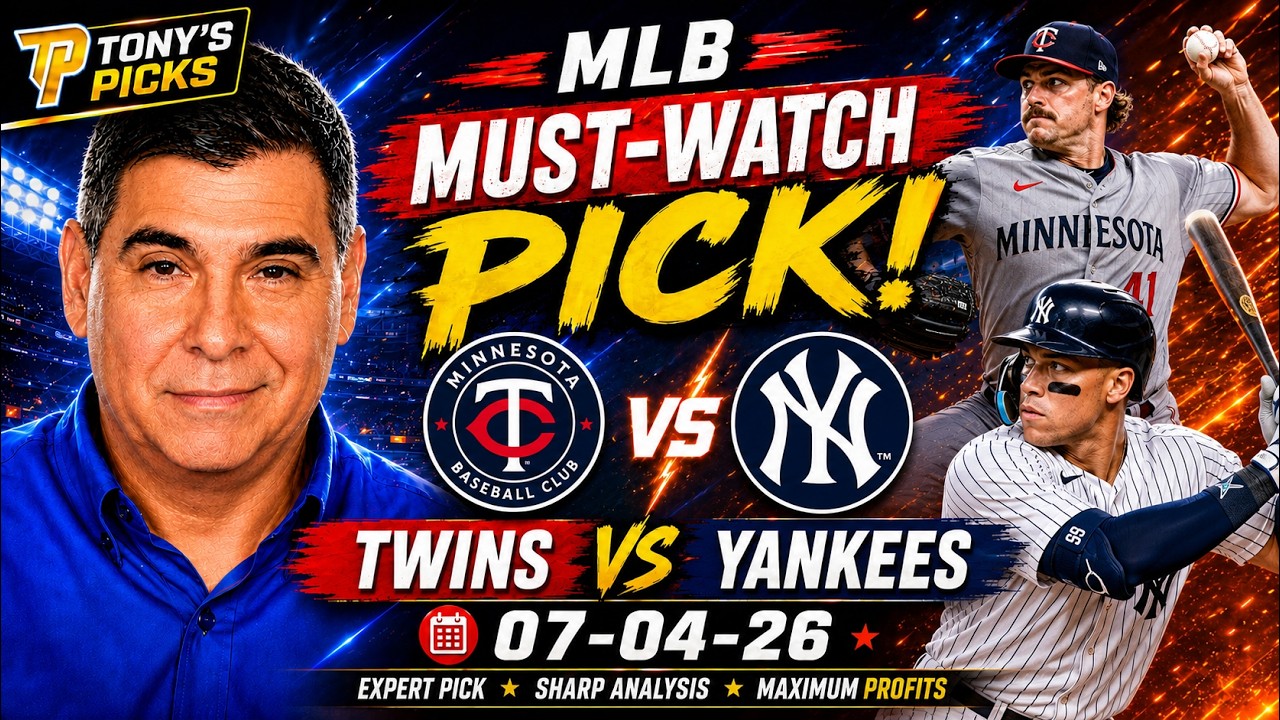

The Minnesota Twins visit the New York Yankees on the Fourth of July with the market leaning heavily on the pinstripes — and on reputation. Tony Tellez is taking the other side at plus-141, because the last month of baseball says the wrong team is favored: Minnesota owns the dramatically hotter offense, the visiting starter has been trending up, and the Yankees’ home-favorite profile has been quietly burning money all season.
Big-market home favorites carry a persistent public tax, and holiday games in the Bronx maximize it. When the underlying form runs opposite the price, that tax becomes the visitor’s value. Here is the full breakdown behind Tony’s play.
Matchup Overview
Minnesota’s offense has been legitimately excellent for a month: a .265 average over its past 26 games with a .471 slugging percentage. That slugging figure is elite territory — the Twins are hitting for average and driving the ball, and the production has come throughout the order rather than from one hot bat.
New York’s month is the inverse: a .221 average with a .285 on-base percentage over the same window. Those are among the worst offensive numbers in baseball across a 26-game sample. The Yankees’ name and their building carry the price today; their bats, on current form, do not.
Starting Pitching Breakdown
Zebby Matthews takes the ball for Minnesota with quietly solid numbers: a 4.15 ERA and a tidy 1.14 WHIP across nine starts, striking out 20 percent against just 5 percent walks. The strike-throwing profile matters enormously against this Yankees lineup — a team reaching base at .285 cannot manufacture offense against a starter who refuses to walk anyone.
Matthews has also shown clear improvement across his past five starts, sharpening his secondary stuff and pitching deeper into games. His 1.8 homers per nine is the flaw, but it plays down against a lineup slugging as poorly as New York has for a month — solo homers are survivable when nobody is on base ahead of them.
Carlos Rodon counters with strong season numbers: a 3.30 ERA and 1.25 WHIP through nine starts, striking out 27 percent. The concern is the 13.5 percent walk rate — an enormous figure for a front-line starter, and the specific weakness that Minnesota’s .471-slugging month is built to punish. Walks ahead of extra-base hits are how two-run innings become four-run innings.
Rodon’s volatility profile mirrors the Yankees’ situation: brilliant when ahead in counts, self-destructive when the command drifts. Against the hottest-slugging lineup on the card, his margin for drift is the thinnest it has been all season.
Key Stats and Trends
The system record framing this play: the Yankees entered this series 22-17 as home favorites of -110 or higher — but losing seven units doing it. Winning slightly more than they lose while burning seven units means the market has consistently overpriced them at home, exactly the inefficiency a plus-141 visitor ticket exploits.
The offensive form gap is the widest on the slate: .471 slugging versus .285 on-base over matched 26-game windows. Form gaps this extreme close eventually, but they close on their own schedule — and pricing a slumping lineup as a strong favorite is betting the correction happens today, with a walk-prone starter, against the league’s hottest bats.
Minnesota’s improving rotation form rounds out the case: Matthews’ five-start trajectory means the Twins are not asking a struggling arm to survive the Bronx; they are riding an ascending one against a descending offense.
How the Lineups Stack Up
Minnesota against Rodon is strength against weakness: the Twins’ patient power bats force Rodon’s walk rate into play early, and their .471 slugging converts his free passes into crooked numbers. Even average execution of that formula produces four runs, which Minnesota’s month says is closer to its floor than its ceiling.
New York against Matthews needs its slump to end on demand. A .221/.285 month means rallies have required opponent mistakes, and Matthews’ 5 percent walk rate withholds them. The short porch offers cheap solo homers, but solo homers do not beat a lineup slugging .471 unless the pitching dominates — and New York’s month of offense cannot bank on that.
The bullpens rate close, which leaves the game to the offensive form and the starter volatility — both firmly on Minnesota’s side of the ledger.

Featured Analysts & Cappers
Read free daily matchup breakdowns and track documented betting records.
Betting Angle: Where the Value Is
Plus-141 implies about 41.5 percent for the team with the better month in nearly every measurable category. Neutral-field models built on the past 30 days make Minnesota close to a favorite in this game; the entire price gap is venue and brand. Venue is worth something — but not the full spread between 41 percent and the mid-50s the form suggests.
The seven-units-lost figure as home favorites is the market’s own confession: it has been setting this exact price wrong all season. Public holiday money on the pinstripes only widens the error today. Fading brand-inflated home favorites on national holidays is one of the oldest profitable angles in baseball betting for a reason.
The straight moneyline maximizes the edge; Minnesota’s win distribution includes plenty of tight finals, and the plus-141 payout does not need the cushion a run line would sacrifice.
Schedule and Situational Context
Minnesota arrives playing its best baseball of the season with a settled lineup and no bullpen debt from the previous series. Confident road teams with hot bats treat marquee venues as showcases, and the Twins’ veteran hitters have handled the Bronx well across recent seasons.
New York is managing slump dynamics in a demanding market on a holiday stage: pressing hitters, a walk-prone starter, and a fan base whose patience has thinned. Slumping favorites in front of big expectant crowds have historically underperformed their prices, and every element of that pattern is present today.
The Short Porch, Reconsidered
Yankee Stadium’s right-field porch is the standard rebuttal to any visiting ticket, but it cuts both ways in this matchup. Minnesota’s left-handed pop is well-suited to the same dimensions, and a .471-slugging month travels better into a homer-friendly park than a .285 on-base month defends one. The venue amplifies offense generally — and only one of these offenses currently exists.
Rodon’s fly-ball tendencies in front of the porch add the last layer of favorite fragility. A walk followed by a short-porch two-run shot is the single most common way Yankee home games flip, and Minnesota’s power-patience combination generates exactly that sequence more often than any recent opponent New York has hosted.
None of this requires the Yankees to stay cold forever — only for one more afternoon, against an ascending strike-thrower, at a price that pays 141 for the privilege. Value betting is not predicting the future; it is buying the probability the market refuses to sell at fair price.
Managing the Risk
The honest risks: Rodon’s strikeout ceiling can single-handedly quiet a hot lineup for six innings, and any Bronx game carries one-swing variance late. Both are real, both are priced — that is what the plus-141 is paying for. The bet is not that Minnesota certainly wins; it is that its true probability sits meaningfully above the 41 percent the ticket charges.
Bankroll discipline treats plays like this as portfolio entries rather than convictions: flat-stake the number, let the month-long form gap do its statistical work, and accept that the market’s brand tax on Yankee opponents is the most reliable recurring toll booth in baseball betting.
Final Prediction
Tony Tellez is taking the Minnesota Twins at +141 over the New York Yankees on Saturday, July 4. The .471-versus-.285 form gap, Rodon’s 13.5 percent walk rate against the league’s hottest slugging lineup, Matthews’ ascending five-start form, and New York’s seven units lost as a home favorite make the road dog the clear value.
Expect Minnesota to cash Rodon’s walks into a mid-game lead and hold it. Call it Twins 5, Yankees 3. The play: Twins moneyline at +141.
Please gamble responsibly. Betting involves risk, and you should only wager what you can afford to lose. If you or someone you know has a gambling problem, call 1-800-GAMBLER for confidential support.