
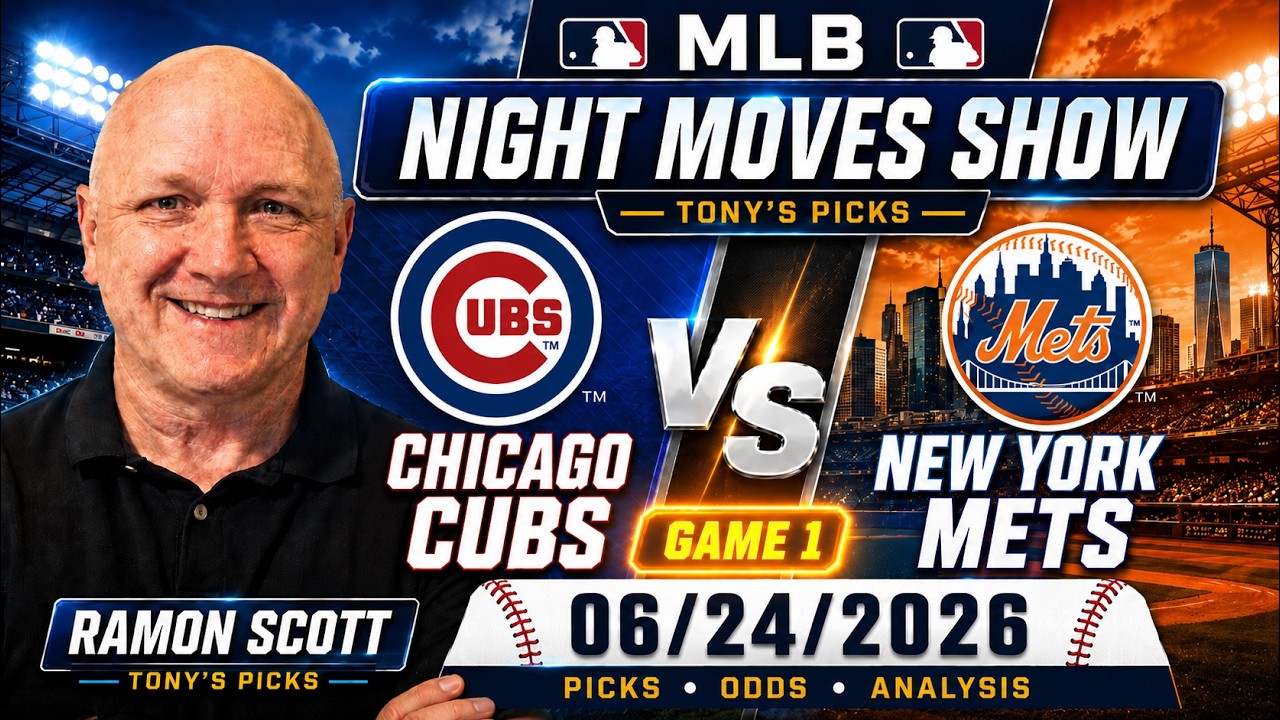

The Chicago Cubs and New York Mets open a day-night doubleheader on Wednesday, June 24, with Game 1 set for 1:10 Eastern. After the Cubs were rained out two straight days, the schedule has compressed into a twin bill, and that wrinkle shapes how Ramon Scott is approaching the opener. His focus here is on the total rather than a side, and he likes what the pitching matchup says about a low-scoring start.
Matchup Overview
Doubleheaders are tricky to handicap because everything has to be pieced together on the fly, and Ramon is candid about that. With the Cubs coming off back-to-back rainouts and now playing two in a day on the road, the rhythm of this game is anyone’s guess. But the starting pitching gives him a foundation to build a read on.
The Cubs took the previous meeting 9-6, and their offense has been coming around, with one hitter in particular staying on fire. Even so, this is a club full of patient hitters who do not strike out much, and that profile matters when projecting a total. Contact-oriented patience can produce runs, but it can also grind into long, low-scoring innings.
Starting Pitching Breakdown
Chicago sends Shota Imanaga to the mound as a road favorite. Imanaga carries a 4.25 ERA with a 4-6 record. The win-loss line is unremarkable, but he is a quality arm capable of controlling a game, and Ramon clearly trusts him to keep the Mets contained in this spot.
New York counters with Nolan McLean, who has been excellent. McLean owns a sparkling 3.67 ERA with a 4-4 record and a tidy 1.09 WHIP. That is genuinely strong starting pitching on the home side, and the combination of two capable arms is the heart of Ramon’s case for the under in Game 1.
Put simply, this is good starting pitching on both sides facing offenses that do not project to explode. Imanaga as a road favorite against a sharp McLean line sets up as the kind of pitching-led game where runs come at a premium, especially in the opener of a long doubleheader day.
Key Stats and Trends
The biggest factor in Ramon’s read is the Mets offense, which he flatly calls one of the worst in the league right now. A crummy lineup facing a quality starter in Imanaga is a recipe for a quiet New York side of the ledger, and that alone does a lot of work toward keeping the total down.
On the Chicago side, the Cubs’ patience cuts both ways. They do not strike out much and grind at-bats, which can manufacture runs, but it can also mean fewer of the quick, explosive innings that blow a total open. Against a pitcher as effective as McLean, that patient approach may translate into traffic without a flood of runs.
Ramon was genuinely surprised by the total when he first saw it. He questioned whether the 8.5 number looked right for this matchup and told viewers to take his read with a grain of salt, since lines can shift overnight. He checked multiple books and found the figure hovering around 8.5, with one shop pricing the over near minus-117.
The Doubleheader Wrinkle
The day-night doubleheader format adds a layer worth pricing in. Game 1 starters often pitch knowing the bullpen has to cover two games, which can influence how aggressively managers push their starters. With both Imanaga and McLean capable of working deep, neither side is necessarily forced into early relief, supporting a lower-scoring opener.
The rainout backstory matters too. Chicago sat through two washed-out days before this twin bill, so timing and rust are genuine unknowns for a Cubs lineup that thrives on rhythm and patient at-bats. Layoffs can dull an offense’s edge, and a slightly cold Chicago bat list only strengthens the case for the under in the first game.
There is also a scheduling reality that Ramon respects: doubleheader openers are notoriously hard to model because the data is thin and the routines are scrambled. That is exactly why he leans on the cleanest available signals, strong pitching and a weak Mets offense, rather than overcomplicating a game with so many moving parts.
Where the Betting Value Is
The value, as Ramon sees it, is in the under at 8.5. He acknowledged the line felt a touch high for a game featuring two solid starters and one of the league’s weakest offenses, and that disconnect is exactly what he wants to attack. If the number drops too low by game time, he is upfront that the edge shrinks.

He is leaning under specifically because the pitching and the Mets’ offensive struggles point the same direction. Imanaga and McLean are both capable of stringing up zeros, and a sputtering New York lineup makes it hard to imagine a shootout in the opener. The patient-but-not-explosive Cubs round out the case.
The chat split, as it often does, with Farley and Cow Dog on the Mets side and Shaq saving his energy for the Marlins game later. Ramon stuck to his number and his process. For more of his free reads and premium plays, his handicapper page is over at tonyspicks.com, where the doubleheader slate gets the full treatment.
One more nuance favors the under: the Cubs took the previous meeting 9-6, a high-scoring result that can artificially nudge a total upward. Books and bettors sometimes anchor to the last game’s score, but the pitching matchup that day was different. A McLean-Imanaga duel projects far tighter than whatever produced 15 combined runs previously.
Ramon’s broader point is about discipline with totals. He flagged that he was surprised by the 8.5 number and questioned it openly rather than blindly firing, which is the right habit. He confirmed the line across multiple books before committing, and that legwork is what separates a reasoned under play from a reflexive one in a tricky doubleheader spot.
How the Game Could Play Out
Picture the likely script: Imanaga works through a patient Cubs-friendly zone while McLean carves up a weak Mets lineup, and the early innings stay quiet. Doubleheader openers often settle into a rhythm where both managers want length from their starters to protect the bullpen for the nightcap, which naturally suppresses scoring in the first game.
The Mets offense is the linchpin. If one of the league’s worst lineups cannot generate traffic against Imanaga, New York may struggle to reach four runs on its own. That puts the entire burden of clearing 8.5 on a Cubs offense that grinds and walks more than it slugs, a profile that produces baserunners but not always the crooked numbers a total needs.
The risk, of course, is a bullpen meltdown late or a sudden Cubs power surge, since Chicago did hang nine on this group recently. But that earlier game featured a different pitching matchup. With two capable starters likely to go deep here, the path to a low-scoring, under-friendly afternoon is the more probable outcome in Ramon’s view.
Bullpen and Closing Considerations
The doubleheader format quietly strengthens the under. Both managers will want length from Imanaga and McLean to spare their bullpens for the nightcap, which discourages early hooks and the kind of reliever parade that inflates totals. Starters left in to work deep tend to keep the run count down, especially when both are pitching well.
Even the late innings favor a quiet finish. A weak Mets offense is unlikely to stage a big rally against Chicago’s relievers, and the patient Cubs are more likely to grind out walks than to slug their way to a crooked number. With neither lineup built for a late explosion, the under has a clear runway through the back half of the opener.
Ramon’s Final Pick
Ramon Scott is taking the UNDER on the Game 1 total of 8.5. The reasoning is clean: two effective starters in Imanaga and McLean, a Mets offense ranked among the league’s worst, and a patient Cubs lineup that grinds more than it explodes. He flagged the number as possibly high, which is the value he is chasing.
The caveat he offered himself is worth repeating. This is a doubleheader opener with a line he expects could move, so if the total drops meaningfully by first pitch, the edge thins out. Confirm the number before committing, stake it responsibly, and treat the lean as a pitching-driven read rather than a lock.
Betting involves risk. Always wager responsibly and only what you can afford to lose. If gambling stops being fun, call 1-800-GAMBLER.